How do you roll out CSR internationally when every subsidiary plays by its own rules?
4 juin 2026
From headquarters strategy to ground-level ownership: the keys to a rollout that genuinely scales.
Rolling out an ESG strategy in a single country is already a demanding exercise. Extending it across several countries, cultures and varying levels of maturity is a different challenge altogether.
Yet that is exactly what many companies are doing as they seek to give global coherence to their sustainability commitments. The stakes go beyond reputation: it is also about steering trajectories (on carbon, for instance) and meeting external reporting requirements, since a parent company can in most cases produce consolidated ESG reporting covering its subsidiaries.
E&H has been supporting these transformations in France for over 20 years, and internationally with more than 2,300 people trained over the past five years and over 35 consulting projects completed in multi-country contexts.
What these experiences consistently reveal is that the international dimension cannot be improvised. It requires adapting approaches, questioning established assumptions and accepting that the same ESG issues do not resonate the same way in Paris, Casablanca, Singapore or Chicago.
A regulatory and cultural landscape that is far from uniform
The CSRD, the European taxonomy, the corporate sustainability due diligence directive (CS3D): these frameworks have become essential reference points for European multinationals. But as soon as you step outside the EU, the regulatory landscape shifts considerably. Some countries are ahead on specific dimensions such as governance or human rights; others are still at early stages when it comes to non-financial reporting or broader corporate social responsibility requirements. Assuming that all subsidiaries or partners within a group share the same understanding of sustainability would be a mistake.
And yet this is the approach used by many parent companies. Subsidiaries are bound by them through their headquarters and are increasingly pushed to integrate sustainability by their business partners as well.
Beyond the regulatory dimension, differences in ESG maturity across geographies play an equally structuring role. A company may have subsidiaries that have been tracking their carbon footprint for years alongside others that have never produced a single impact assessment. These maturity gaps profoundly shape how a strategy is designed, how targets are set, and how teams are onboarded.
Cultural differences matter just as much. What drives engagement on CSR issues among teams in North America or India is not necessarily what motivates employees in Europe. The way environmental impact, social rights or compliance are discussed varies deeply from one context to another. These nuances are not obstacles: properly understood, they become levers for embedding ESG issues more authentically in each local context.
Co-building rather than copy-pasting
A top-down approach creates an appearance of coherence, but it does not produce genuine ownership. The appeal is obvious: a model that radiates from the centre and reaches subsidiary teams quickly, without the time investment of involving local teams in explaining the rationale, making the case for why ESG matters to their business and jobs, and helping them take ownership of the Sustainability strategy and action plan. The result: local teams remain spectators of an initiative they had no hand in building, one more thing “handed down” from headquarters.
Another common difficulty is a local CSR organisation that is too lean: too few dedicated people, a management team that is insufficiently involved, and local CSR leads without real accountability. In these conditions, even a well-crafted strategy fails to take hold on the ground.
E&H’s conviction, shaped by years of client work both in consulting and training, is that co-construction with local teams is the non-negotiable condition for a successful international rollout.4
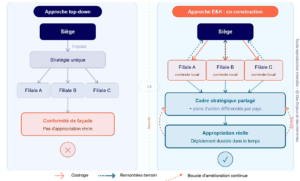
This means going to leverage local networks and expertise, creating space for dialogue with subsidiaries, making room for ground-level realities to surface, and adapting tools and formats accordingly. At the heart of this is one essential word: trust. Trust that the local CSR lead knows better than headquarters which ESG issues are most relevant in their context, which indicators are available and meaningful, and which actions have a real chance of working. This is not translation. It is strategic interpretation.
A second word is equally essential: involvement. CSR initiatives and ESG action plans cannot rest solely on sustainability specialists. The involvement of local leadership is critical to securing the allocation of resources (financial, human) to ESG actions. A further challenge then follows: how do you enable frontline managers to talk credibly about CSR to their teams, in a way that connects to the concrete realities of their day-to-day work? An external trainer or consultant can prepare the content and help carry it out. But accountability must sit with the managers themselves, through a process of dialogue, co-construction and genuine empowerment.
This is how we have been able to co-facilitate working sessions and roll out CSR strategies with thousands of employees through train-the-trainer programmes (for example: 200 trainers who train 2,000 managers who engage 20,000 employees across 50 countries). We supported Groupe THOM in rolling out their CSR strategy across 3 countries (France, Germany, Italy) through exactly this kind of programme. Watch the THOM Group case (video in French) .
Sometimes, bringing together these cross-cultural perspectives and different levels of organisational integration is what makes the deliverable genuinely meaningful. For UPERIO, an international tower crane services group operating in 8 countries, E&H facilitated the co-construction workshops, bringing together teams from 5 different nationalities (France, UK, Germany, Belgium, USA) around a shared reflection around the company’s Purpose. The result was a remarkable convergence of aspirations, despite very different corporate cultures.
Two areas of expertise, one shared goal
What sets E&H apart in international projects is the ability to draw simultaneously on two mutually reinforcing areas of expertise: ESG strategy consulting on one side, and adult pedagogy and training on the other.
On the consultancy side, this means supporting both headquarters and subsidiary leadership teams in defining an ESG strategy that makes sense at group level, by integrating double materiality approach. Ideally this involves mobilising stakeholders not only at headquarters but across different geographies, in order to build a shared foundation and realistic, country-specific action plans.
On the training side, it means deploying skills development programmes on sustainability across countries, adapting to different languages, audiences and company functions (procurement, sales, managers, CSR leads…). This leads us to find the right response by combining synchronous learning (remote and in-person sessions) with e-learning foundations. For example, we were able to train European teams at Beneo, across management, marketing, sales and HR, in multiple languages. Read the Beneo case.
This dual expertise is what allows E&H to support clients along the full journey, from strategy through to changes in day-to-day practices, including when teams are on the other side of the world. This is what we invite you to explore across the next three articles in this series!
Would you like to discuss an international ESG project? Get in touch with us
Discover some of our references on our case study page + achievements E&H
Next article: How to build a robust ESG strategy in a multi-country context & insights from our international advisory missions.